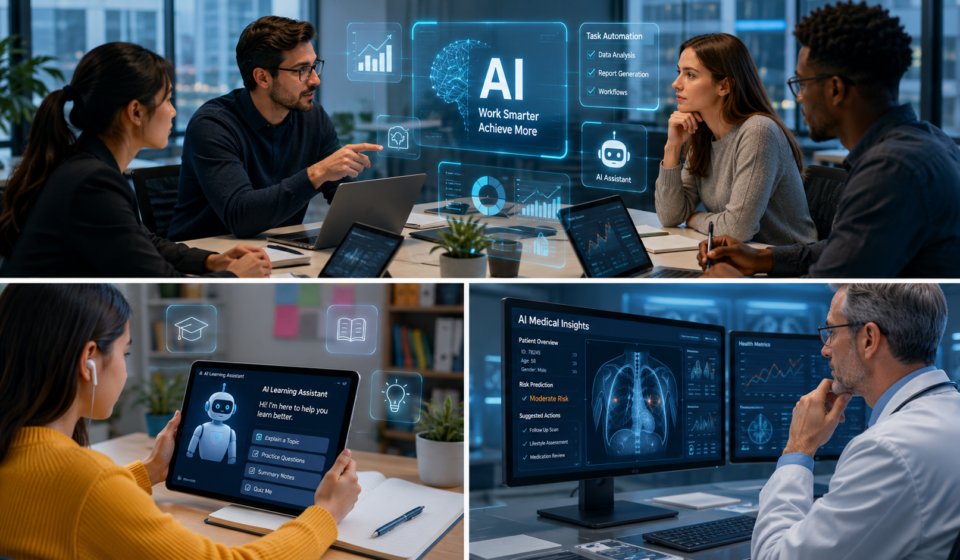

Artificial intelligence isn’t just a buzzword anymore. It’s becoming part of everyday life, and honestly, it’s happening faster than most people expected. Whether you’re using AI to write emails, organize your schedule, edit photos, or even plan your next vacation, chances are you’re already relying on it more than you realize.
The biggest AI Trends 2026 aren’t about robots taking over the world. They’re about smarter software, better productivity, personalized experiences, and tools that make daily tasks easier. That’s the exciting part. AI is quietly becoming your digital helper instead of some futuristic technology you only see in movies.
If you’ve been wondering what’s actually changing right now – and what matters to regular people instead of tech experts – you’re in the right place.
In this guide, we’ll break down the most important AI trends shaping 2026 using simple language, real-world examples, and practical advice you can actually use.
Let’s dive in.
Table of Contents
Why AI Feels Different in 2026
A few years ago, AI was mostly something tech companies talked about. It sounded impressive, but many people didn’t know how it fit into everyday life.
Fast forward to 2026, and things have changed dramatically.
Now AI is built into phones, laptops, web browsers, online shopping, banking apps, healthcare services, schools, and workplaces. Instead of being a separate tool, it’s becoming part of the apps you already use every day.
Think about it.
You might already use AI when you:
- Write emails
- Translate languages
- Summarize long documents
- Generate images
- Remove unwanted objects from photos
- Get customer support
- Plan trips
- Learn new skills
- Shop online
- Organize your calendar
The funny part ?
Many people don’t even realize they’re using AI anymore. It’s becoming as normal as using Wi-Fi.
That’s one of the biggest AI Trends 2026 – AI is becoming invisible while making everything work a little smarter.
Read also :- Best AI Writing Tools Compared for Bloggers in 2026
AI Is Becoming Everyone’s Personal Assistant
One of the most noticeable AI trends is the rise of intelligent personal assistants.
These aren’t the simple voice assistants from years ago that struggled to answer basic questions.
Today’s AI assistants can:
- Plan your day
- Draft professional emails
- Summarize meetings
- Create presentations
- Analyze spreadsheets
- Recommend travel plans
- Help with homework
- Write social media posts
- Brainstorm business ideas
Instead of switching between five different apps, many people simply ask an AI assistant to handle several tasks at once.
For example:
Imagine you have a business trip next week.
Instead of spending an hour organizing everything, you could simply ask your AI assistant:
“Find the cheapest flight, book a hotel near my meeting location, create a three – day itinerary, remind me to pack my laptop charger, and summarize tomorrow’s meetings.”
That’s a huge time saver.
For busy professionals, students, and even families, AI assistants are becoming digital teammates rather than simple tools.
Why This Matters
Saving five minutes here and there doesn’t sound like much.
But over weeks and months, those minutes add up.
Many people report using AI to reduce repetitive work so they can spend more time on creative projects, hobbies, or simply relaxing after work.
Instead of replacing people, AI often removes the boring parts of a task.
That’s a much more realistic picture than the dramatic headlines you sometimes see online.
Smarter AI Search Is Replacing Traditional Search
Have you noticed that searching online feels different now ?
Instead of opening ten websites and comparing information yourself, many AI-powered search tools provide a clear summary in seconds.
This is changing how people find information.
Traditional search usually looks like this:
- Search a question.
- Open several websites.
- Compare answers.
- Decide which one seems trustworthy.
AI search often works like this:
- Ask a question.
- Receive a summarized explanation.
- Explore trusted sources if needed.
For example, instead of searching:
“How do I start investing ?”
People now ask:
“I’m 25 years old, have $ 300 each month to invest, and want long-term growth. What’s a good beginner strategy?”
AI understands context much better than traditional search.
That makes the answers more useful and personalized.
The Catch
AI isn’t perfect.
Sometimes it can misunderstand information or confidently provide incorrect answers.
That’s why it’s still important to verify facts using trusted organizations, official government websites, universities, or well-known industry experts.
Think of AI as a helpful research assistant – not the final authority.
AI at Work: The New Everyday Coworker
Perhaps the biggest shift in AI Trends 2026 is happening in workplaces across the United States.
Companies of all sizes are finding practical ways to use AI – not to replace employees, but to help them work faster and smarter.
Here are just a few examples:
Marketing Teams
AI helps generate content ideas, analyze campaign performance, write ad copy, and personalize customer messages.
Instead of starting from a blank page, marketers can begin with a solid first draft and spend more time improving creativity and strategy.
Customer Service
Many businesses now use AI chatbots to answer common questions 24 / 7.
Customers get instant responses for simple issues, while human support agents focus on more complex problems that require empathy and experience.
That means shorter wait times and better overall service.
Software Development
Developers use AI to:
- Suggest code
- Find bugs
- Explain complex programming concepts
- Speed up testing
- Improve documentation
This doesn’t eliminate the need for skilled programmers – it simply helps them solve problems more efficiently.
Read also :- Best AI Writing Tools Compared for Bloggers in 2026
Healthcare
Doctors and medical staff are using AI to organize patient records, summarize medical notes, and assist with identifying patterns in medical images.
These tools support healthcare professionals, but important medical decisions still rely on trained experts.
Education
Teachers are using AI to:
- Create lesson plans
- Design quizzes
- Generate classroom activities
- Personalize learning materials
Students, meanwhile, use AI to explain difficult topics, organize study schedules, and review concepts before exams.
Like calculators changed math classes decades ago, AI is becoming another helpful learning tool—when used responsibly.
A New Skill Everyone Is Learning
In the past, computer skills meant knowing how to use spreadsheets or presentation software.
Today, one of the most valuable skills is knowing how to work effectively with AI.
People who can write clear prompts, evaluate AI-generated information, and combine human creativity with AI assistance are becoming increasingly valuable in many industries.
It isn’t about competing with AI.
It’s about learning how to make AI work for you.
AI Is Transforming Healthcare Faster Than Ever
Healthcare is one of the industries seeing some of the biggest benefits from artificial intelligence. While AI isn’t replacing doctors or nurses, it is helping them work more efficiently and make informed decisions.
Think of AI as a highly organized assistant that can process huge amounts of information in seconds.
Today, many hospitals and clinics use AI to:
- Analyze medical images
- Organize patient records
- Schedule appointments
- Predict potential health risks
- Reduce paperwork
- Support faster diagnoses
This allows healthcare professionals to spend more time focusing on patients instead of administrative tasks.
For example, imagine a doctor reviewing hundreds of X – rays every week. AI can quickly highlight images that may need extra attention. The doctor still makes the final decision, but AI helps prioritize the workload.
That’s a win for both healthcare workers and patients.
Read also :- Best AI Writing Tools Compared for Bloggers in 2026
Wearable Devices Are Getting Smarter
Smartwatches and fitness trackers have come a long way.
In 2026, many wearable devices do much more than count your daily steps.
Modern AI-powered wearables can:
- Monitor heart rate
- Track sleep quality
- Detect unusual activity
- Measure stress levels
- Remind users to stay active
- Encourage healthier habits
While these devices aren’t medical replacements, they can help people notice patterns they might otherwise miss.
For example, if your smartwatch notices an unusual change in your heart rate over several days, it may recommend speaking with a healthcare professional.
Small reminders like these can encourage healthier lifestyles before problems become more serious.
AI Is Making Education More Personal
Education has changed dramatically over the past few years, and AI is becoming one of the biggest reasons why.
Every student learns differently.
Some prefer videos.
Others like reading.
Some learn best through practice.
Traditional classrooms often have one teacher helping many students at once, making personalized learning difficult.
AI is changing that.
Instead of giving every student the exact same lesson, AI can adapt learning materials based on individual progress.
For example, if a student struggles with algebra, an AI tutor may provide:
- Simpler explanations
- Additional examples
- Practice questions
- Step-by-step solutions
- Progress tracking
Meanwhile, students who master the topic quickly can move ahead without waiting for the rest of the class.
This creates a learning experience that feels much more personalized.
Teachers Benefit Too
It’s not just students who benefit.
Teachers often spend hours each week creating lesson plans, grading assignments, and preparing quizzes.
AI can assist by:
- Drafting lesson plans
- Creating worksheets
- Generating quizzes
- Summarizing student performance
- Suggesting classroom activities
Instead of replacing teachers, AI helps reduce repetitive work so they can spend more time interacting with students.
After all, no technology can replace the encouragement, creativity, and empathy that great teachers bring into the classroom.
Small Businesses Are Adopting AI Faster Than Ever
Not long ago, advanced AI tools were mostly available to large companies with huge technology budgets.
That has changed.
Today, affordable AI tools are helping small businesses compete with much larger brands.
Whether you run a coffee shop, an online store, a local repair service, or a small marketing agency, AI can help simplify daily operations.
Common uses include:
- Writing product descriptions
- Responding to customer questions
- Managing appointments
- Creating marketing campaigns
- Designing social media graphics
- Tracking inventory
- Analyzing sales trends
Many small business owners say AI helps them save several hours every week.
That’s valuable time they can spend improving products, serving customers, or growing their business.
Read also :- Best AI Writing Tools Compared for Bloggers in 2026
Example: A Local Bakery
Imagine a neighborhood bakery.
Before AI, the owner might spend hours every weekend creating social media posts, answering online messages, and updating the website.
Now an AI assistant can help:
- Suggest Instagram captions
- Write promotional emails
- Create seasonal menu ideas
- Respond to common customer questions
- Analyze which products sell best
The bakery owner still makes the final decisions, but AI removes much of the repetitive work.
AI Creativity Is Reaching a New Level
One of the most exciting AI Trends 2026 is how creative these tools have become.
AI is no longer limited to writing simple text.
Today’s AI can help create:
- Images
- Music
- Videos
- Presentations
- Logos
- Website designs
- Marketing campaigns
- Story ideas
- Animations
Creative professionals are using AI as a brainstorming partner rather than a replacement.
For example, a graphic designer might ask AI to generate several rough concepts before creating the final design manually.
A writer might use AI to overcome writer’s block.
A video creator could use AI to generate captions, scripts, or editing suggestions.
The human still provides the vision.
AI simply speeds up the process.
Creativity Still Needs Human Judgment
One common misconception is that AI automatically creates perfect content.
That’s rarely true.
The best results usually come from people who:
- Review AI output carefully
- Edit for accuracy
- Add personal experiences
- Improve clarity
- Include original ideas
Think of AI as a talented assistant – not the entire creative team.
Shopping Is Becoming More Personalized
Online shopping has become much smarter thanks to AI.
Instead of showing the same products to everyone, many retailers now personalize recommendations based on browsing habits and preferences.
For example, if you frequently search for hiking gear, AI may recommend:
- Hiking boots
- Camping equipment
- Outdoor jackets
- Travel backpacks
- Trail guides
This makes shopping faster because you’re more likely to see products that match your interests.
Of course, personalization also raises important privacy questions, which we’ll discuss later in this article.
Virtual Shopping Assistants
Many online stores now include AI shopping assistants.
Instead of scrolling through hundreds of products, you can simply ask questions like:
- “Which laptop is best for college ?”
- “Show me waterproof hiking shoes under $ 150.”
- “What’s a good beginner camera?”
The AI narrows the options, making it easier to compare products.
You still choose what to buy – but with less searching.
Entertainment Is Becoming More Interactive
AI is also changing how we watch movies, listen to music, and play games.
Streaming platforms use AI to recommend content based on your interests.
Gaming companies use AI to create smarter characters and more realistic experiences.
Music platforms suggest playlists that match your mood.
Even video editing has become much easier thanks to AI-powered tools that automatically remove background noise, improve lighting, or generate subtitles.
These improvements happen behind the scenes, making entertainment feel smoother without most users even noticing.
AI Is Strengthening Cybersecurity
As AI becomes more powerful, cybercriminals are also finding new ways to misuse technology.
Fortunately, AI is helping cybersecurity experts fight back.
Many security systems now use AI to:
- Detect unusual login attempts
- Identify suspicious transactions
- Block phishing attacks
- Monitor network activity
- Flag potential threats before damage occurs
For example, if someone suddenly logs into your account from another country using an unfamiliar device, AI may temporarily block the login and ask for additional verification.
This helps protect personal information and reduces online fraud.
Read also :- Best AI Writing Tools Compared for Bloggers in 2026
Why Personal Cybersecurity Matters
Even with smarter security systems, you still play an important role.
Here are a few simple habits that make a big difference:
- Use strong, unique passwords.
- Turn on two – factor authentication.
- Be cautious of unexpected emails or messages.
- Keep your devices updated.
- Verify information before clicking unfamiliar links.
AI can improve security, but smart online habits remain essential.
AI Ethics and Responsible Development
As AI becomes part of everyday life, people are asking bigger questions.
Questions like:
- Can AI be trusted ?
- Who is responsible when AI makes mistakes ?
- How should personal data be protected ?
- Should AI-generated content always be labeled ?
These conversations are becoming increasingly important.
Governments, universities, and technology companies are working together to develop guidelines that encourage responsible AI development while protecting users.
The goal isn’t to slow innovation.
It’s to make sure AI is safe, transparent, and beneficial for everyone.
Why Responsible AI Matters
Most people want AI that is:
- Fair
- Accurate
- Secure
- Transparent
- Respectful of privacy
- Easy to understand
Companies that prioritize these values are more likely to earn public trust over the long term.
As AI continues to evolve, responsible development will likely become one of the defining trends of the decade.
Helpful Resources
If you’d like to learn more about trustworthy AI and emerging technology, these organizations offer reliable information:
- National Institute of Standards and Technology (NIST): https://www.nist.gov
- MIT Technology Review: https://www.technologyreview.com
- Stanford Human – Centered AI (HAI): https://hai.stanford.edu
These sources regularly publish research, practical guides, and updates on AI developments.
What’s Next for AI Beyond 2026 ?
If there’s one thing we’ve learned over the past few years, it’s that AI moves fast. Features that sounded futuristic just a year ago are now part of everyday apps.
So, what comes next ?
No one can predict the future with 100% accuracy, but several trends are already becoming clear.
1. AI Will Become More Personalized
Future AI assistants will better understand your preferences, habits, and goals – with your permission. Instead of giving generic answers, they’ll provide suggestions tailored to your situation.
Imagine asking:
“Plan healthy meals for this week based on my budget, my food allergies, and the groceries already in my kitchen.”
That’s the direction AI is heading.
Read also :- Best AI Writing Tools Compared for Bloggers in 2026
2. AI Will Work Across More Devices
Right now, many people use AI through websites or smartphone apps.
Over the next few years, expect AI to be built into:
- Cars
- Smart TVs
- Home appliances
- Wearable devices
- Office software
- Customer service systems
Instead of opening a separate AI app, you’ll simply interact with AI wherever you are.
3. Better Collaboration Between Humans and AI
One of the biggest myths about AI is that it will replace every job.
In reality, many workplaces are discovering that the best results happen when people and AI work together.
Humans still bring:
- Creativity
- Critical thinking
- Emotional intelligence
- Leadership
- Ethics
- Real-world experience
AI brings:
- Speed
- Automation
- Data analysis
- Pattern recognition
- Organization
That combination is incredibly powerful.
4. Stronger AI Regulations
As AI becomes more common, governments and technology companies are creating clearer rules around:
- Privacy
- Data security
- Copyright
- Transparency
- Responsible AI development
These regulations are designed to protect users while allowing innovation to continue.
How You Can Prepare for the Future of AI
The good news?
You don’t need to become a software engineer to benefit from AI.
Here are a few practical ways to stay ahead:
Learn How to Write Better Prompts
The better your instructions, the better AI performs.
Practice asking clear, detailed questions instead of very short prompts.
Stay Curious
New AI tools appear almost every month.
Try exploring one new tool occasionally. You don’t have to master everything at once.
Verify Important Information
AI is helpful, but it’s not perfect.
Double-check facts related to:
- Health
- Legal matters
- Taxes
- Financial decisions
- Academic research
Reliable sources and human experts still matter.
Keep Building Human Skills
Communication, creativity, teamwork, leadership, and problem-solving remain valuable no matter how advanced AI becomes.
Technology changes.
Strong human skills stay useful.
Read also :- Best AI Writing Tools Compared for Bloggers in 2026
Final Words on AI Trends 2026
The biggest AI Trends 2026 aren’t about science fiction – they’re about making everyday life a little easier.
From smarter workplaces and personalized education to improved healthcare and small business tools, AI is becoming a practical partner rather than just an exciting new technology.
Of course, challenges remain. Privacy, ethics, and responsible development will continue to shape how AI evolves. But one thing is clear: AI isn’t going away.
If you embrace it with curiosity, keep learning, and use it responsibly, you’ll be in a great position to take advantage of the opportunities ahead.
The future of AI isn’t about replacing people.
It’s about helping people do more, learn faster, and solve problems in smarter ways.


[…] Read also :- AI Trends 2026: What Is Changing Right Now ? […]